
Florida college news roundup, October 19th to 25th, 2026. Everything below happened last week at UF, FSU, UCF, USF, straight from each university's own newsroom.
The week of October 19th to 25th brought four Florida universities concrete wins: a federal research leadership role, major lab funding, a new transfer-to-career program, and a research funding record. None of these move the needle on admissions selectivity this year, but each signals where these schools are heading and what resources your kid would have access to if admitted.
The short version
- UF: UF is leading a $75 million U.S. State Department agricultural biosecurity lab, signaling research strength but not changing admissions odds.
- FSU: FSU's national lab won $18 million in NSF funding to build a world-class nuclear magnetic resonance facility.
- UCF: UCF launched the Pegasus Launch Program, a curriculum-to-career initiative specifically designed to connect transfer students to employment.
- USF: USF reached a record $775 million in research funding in fiscal year 2026, up 3 percent from the previous year.
What does UF's new federal research role mean for applicants?
UF is leading a $75 million U.S. State Department agricultural biosecurity lab, signaling research strength but not changing admissions odds.
The University of Florida was selected to lead the SAFE Lab, a U.S. Department of State-funded initiative to detect and contain crop pests and diseases overseas before they threaten American farms. The lab will work across seven countries using AI, crop modeling, diagnostics and risk mapping. UF's Institute of Food and Agricultural Sciences will direct the effort.
This is institutional credibility at scale. A leadership role like this means UF researchers get first access to federal funding and students get closer to cutting-edge work. Our admissions data shows UF admits about 20 percent of applicants, with middle-50 SAT scores between 1420 and 1520, so this news doesn't shift who gets in, but it does confirm you're sending your kid somewhere that gets real resources if they want to do research there.
Source: news.ufl.edu · What UF takes to get in
How strong is FSU's research infrastructure compared to peers?
FSU's national lab won $18 million in NSF funding to build a world-class nuclear magnetic resonance facility.

The National High Magnetic Field Laboratory at FSU received $18 million from the National Science Foundation to construct a new 23.5-tesla NMR magnet, ranked among the strongest in the United States. The facility will accelerate research across biotechnology, energy, advanced manufacturing and health. Lead researcher Frederic Mentink-Vigier called it an instrument that is unique in the world.
This is the kind of infrastructure that attracts top faculty and gives undergraduates real lab access. FSU admits about 22 percent of applicants, with middle-50 SAT scores between 1380 and 1480. If your kid is interested in chemistry, physics, or materials science, this kind of equipment becomes part of the case for attending FSU over a peer school.
Source: news.fsu.edu · What FSU takes to get in
Does UCF have a job placement program for transfer students?
UCF launched the Pegasus Launch Program, a curriculum-to-career initiative specifically designed to connect transfer students to employment.
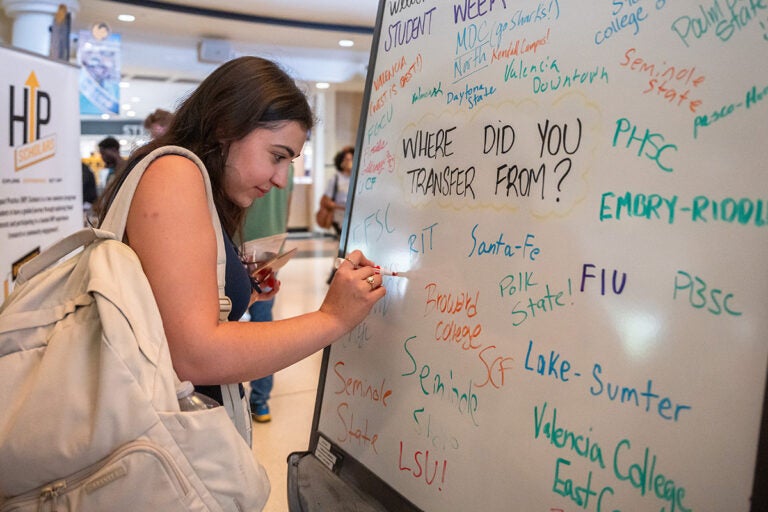
UCF announced the Pegasus Launch Program, funded by the Michael and Susan Dell Foundation, to improve post-graduation employment and graduate school placement for transfer students. The program connects students with career preparation, mentorship, internships, work-based learning and undergraduate research. UCF serves nearly half of its 60,300 undergraduates through transfer pathways. Graduation data shows transfer students are less likely to secure post-graduation opportunities than students who began at UCF, but those who engaged in hands-on learning like research and internships were significantly more likely to have secured opportunities at graduation.
If your kid is planning to transfer to UCF from a Florida community college, this program changes the answer to a concrete question: will I graduate job-ready? UCF admits about 41 percent of applicants, with middle-50 SAT scores between 1310 and 1420. Transfer students historically lag in career placement here, so a structured program with mentorship and internship pathways is real news if transfers are on your kid's plan.
Source: ucf.edu · What UCF takes to get in
How much research funding does USF actually have?
USF reached a record $775 million in research funding in fiscal year 2026, up 3 percent from the previous year.
The University of South Florida reported $775 million in total research funding for fiscal year 2026, a 3 percent increase from the prior year. Over the past five years, USF's research funding has grown 42 percent, combining gains in federal dollars and private sector partnerships. Research spans healthcare, cybersecurity, transportation and other disciplines across multiple colleges.
This number tells you something concrete: USF is getting stronger and more money is flowing to researchers there. Our admissions data shows USF admits about 41 percent of applicants, with middle-50 SAT scores between 1290 and 1420. A 42 percent jump in research funding over five years means the university is investing in faculty and infrastructure, which eventually affects what's available to undergraduates who want lab access or research mentorship.
Source: usf.edu · What USF takes to get in
What this week means for your student
Not sure what these schools actually require? Our Florida College Playbook has the SAT scores and GPAs for the top five, plus the Bright Futures cutoffs and a checklist by grade. Book a free SAT Game Plan call and we will map the score your student needs for the school on their list.
This roundup covers October 19th to 25th, 2026. We publish one every week, compiled from the Florida universities' own newsrooms.