
You do not need to wait for PSAT scores before starting SAT prep. For a sophomore, waiting a few weeks rarely hurts, but it rarely helps either, because a good tutor will start with a full practice SAT that shows far more than the PSAT score report.
How a Sophomore With a 980 Should Plan for Virginia Tech. Carson Flowers · 2:08 · October 26, 2026 · Jump to: 0:00 The question, 0:11 Carson's answer, 1:41 What to do next
| SAT test date | Registration deadline |
|---|---|
| Aug 22, 2026 | Aug 7, 2026 |
| Sep 12, 2026 | Aug 28, 2026 |
| Oct 3, 2026 | Sep 18, 2026 |
| Nov 7, 2026 | Oct 23, 2026 |
| Dec 5, 2026 | Nov 20, 2026 |
| Mar 6, 2027 | Feb 19, 2027 |
| May 1, 2027 | Apr 16, 2027 |
| Jun 5, 2027 | May 21, 2027 |
On this page
Does waiting for PSAT scores hurt a sophomore's SAT prep?
Why the PSAT score report rarely changes the plan
When the score gap is big, the extra weeks start to count
The misconception: you need the official PSAT score to know where to start
Does waiting for PSAT scores hurt a sophomore's SAT prep?
For most sophomores, a few weeks of waiting will not make or break anything. If your teen took the PSAT in October and the first SAT you are aiming for is the March 6 test, prep would not start right away anyway. Carson's view is simple: if you want to see the official number first, that is okay.
His words on a question we hear a lot, whether a family can start classes after the PSAT results come back: "What are you gonna wait, a couple more weeks?" For a sophomore with plenty of runway, the calendar is forgiving. Many families in this spot pre-enroll in a spring class so the seat and the schedule are settled, then let the scores arrive while nothing is lost.
The catch comes for juniors, and for any student with a big gap between today's score and the target. Then the weeks start to matter, and the reasons to wait get thinner.
If you want a plain way to size that gap before the PSAT report lands, our free SAT gap guide walks you through it in one sitting.
Free guide
See exactly where your teen's points are hiding.
A short guide to finding the questions that cost the most points, and what to practice first.
Why the PSAT score report rarely changes the plan
The PSAT score tells you roughly where your teen stands, and a practice SAT tells a tutor what to fix. That difference is why Carson says waiting "doesn't really help you."
Think about what happens the day the score arrives. You read the number. Then, in almost every family, the next thought is "she's going to need prep anyway." The exception is a student already near the top of the scale, and as Carson puts it, parents usually know whether that is their child. No judgment either way.
Once prep begins, the tutor will have your teen sit a full practice SAT. Tutoring software tracks every answer, so it shows the exact types of questions your teen is missing and whether the trouble is content or test-taking strategy, such as rushing the last questions of a module. The PSAT report cannot show that level of detail. So the official score ends up being a reference point while the real starting line is drawn by the practice test.
There is also a scale difference worth knowing. The PSAT/NMSQT is scored 320 to 1520, while the SAT runs 400 to 1600, so the two numbers are not identical. We explain how closely they track in how the PSAT compares to the SAT.
When the score gap is big, the extra weeks start to count
A student who needs to raise a score by hundreds of points benefits from every month of runway. This is the part of Carson's answer families should not skip.
Picture a sophomore scoring around 980 who hopes to get into a highly competitive school like Virginia Tech. Carson's read: "She's gonna need to raise her SAT score maybe, you know, hundreds of points." Closing a gap of 200, 300 or 400 points usually means a considerable amount of prep, and often more than one SAT sitting. In his words, "the earlier she starts, the more time she has to prep, and the better she'll do."
Multiple sittings help because many colleges superscore, taking the best Reading and Writing and the best Math across test dates. Policies are each college's own, so check each college's policy on its admissions page. More shots on goal is the reason Carson calls sophomore year his favorite year to start.
So waiting a few weeks for a PSAT report is fine. Waiting until junior spring to see how things go is a different decision, and that one does cost time.
The misconception: you need the official PSAT score to know where to start
You do not need the PSAT to find your teen's starting point, because a diagnostic practice SAT does that job better. Many parents treat the PSAT result as a required first step, and some use it to put off a decision that would be the same either way.
Carson is direct about this: "Waiting really does nothing except I think it's just procrastination to not make a decision about prep." That is not a scolding. It is a reminder that the score rarely changes the answer, so there is no harm in deciding now and starting when the schedule allows.
The same logic applies to a related question, whether your teen should sit a real SAT first to get a baseline. We cover that in whether to take the SAT before starting prep.
A sensible timeline for a sophomore after the October PSAT
Choose the first SAT date, count back about two months, and start prep there, PSAT scores or not. Carson's general rule is that a student should begin prep when they have time, and sophomore year usually has more of it than junior year.
A plan many families follow looks like this:
- In the fall, after the PSAT, pick a first SAT date. March 6, 2027 is a common choice, with registration due February 19.
- Through winter, pre-enroll so the class or tutor fits around sports and school.
- When prep begins, start with a full practice SAT so the plan is built on real data.
- Leave May 1 or June 5 open as a second attempt if the first score falls short.
Real students have moved meaningfully in that kind of window. Jonathan, a homeschooled 10th grader, went from 1020 to 1220 in 8 weeks, with sessions fit before football practice and games. Kira, a sophomore, went from 1270 to 1400 in 10 weeks. Every student is different, and those numbers describe what they did, not a forecast. For how many hours a week that usually takes, see how long to study for the SAT.
If you would like a simple worksheet for mapping your teen's score, target and test dates, download our free SAT gap guide and have the plan on paper before the PSAT report even arrives.
More answers from Carson
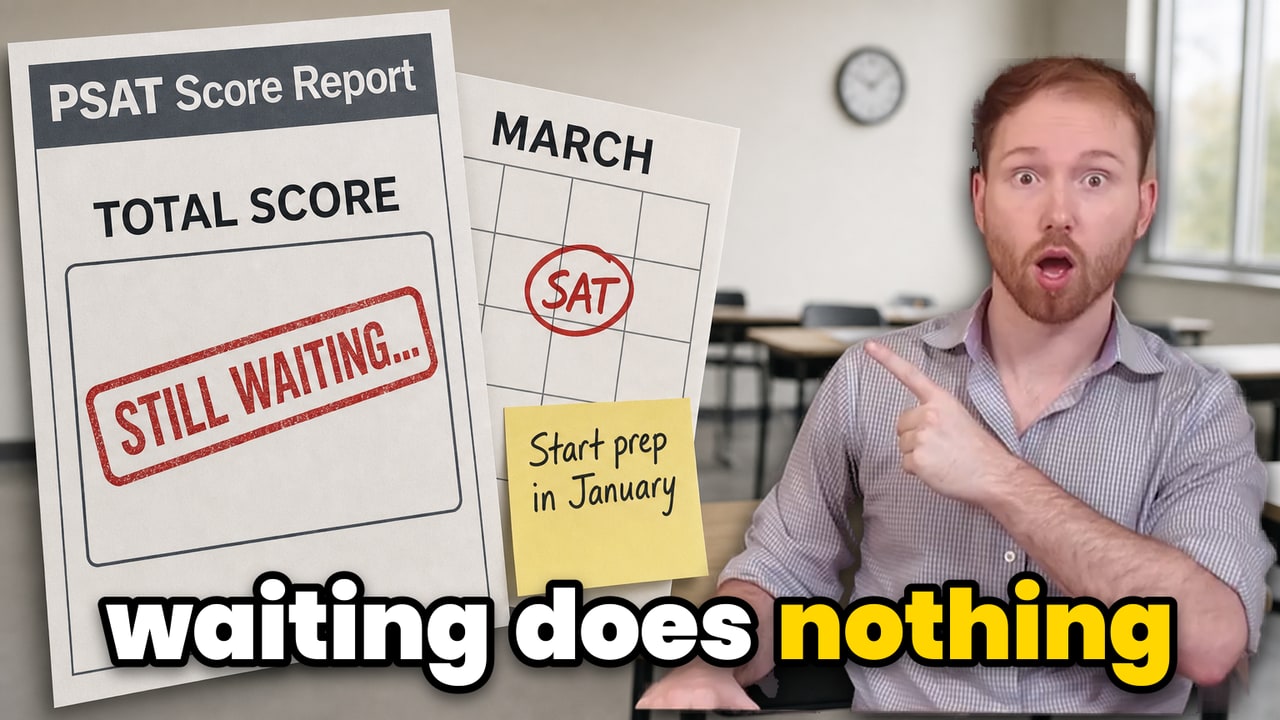 Sophomores Don't Need PSAT Scores to Start an SAT Plan
Quick answers
Is sophomore year too early to start SAT prep?
No, Carson calls sophomore year his favorite year to start. Starting early leaves room for several SAT attempts before college applications.
Is a PSAT score on the same scale as the SAT?
Not quite. The PSAT/NMSQT is scored 320 to 1520, while the SAT is scored 400 to 1600, with two sections of 200 to 800 each.
Does a sophomore's PSAT count for National Merit?
No, the PSAT/NMSQT is the National Merit qualifying test for juniors. A sophomore PSAT is useful practice and a rough checkpoint.
Should my teen take a practice SAT before starting prep?
Yes, a full practice SAT is the usual first step. It shows which question types and strategy habits are costing points, which the PSAT report cannot show.
Will colleges combine scores from more than one SAT?
Many do. Superscoring takes the best section scores across sittings, but each college sets its own policy, so check each one.
Sources
Free guide
Get the free SAT Gap Guide.
A short guide to finding the questions that cost the most points, and what to practice first.
What's new on this page
October 27, 2026: Published.