
Most teens should study for the SAT for 8 to 12 weeks to make a large jump, such as 150 to 200 points, and more time tends to mean a bigger increase. Anything under six weeks is a crash course, and big gains from one are the exception.
How Long Should a Senior Prep for the SAT? Carson Flowers · 2:07 · October 18, 2026 · Jump to: 0:00 The question, 0:13 Carson's answer, 1:37 What to do next
| Prep time | Score change | Where the number comes from |
|---|---|---|
| 6 to 8 hours on Official SAT Practice | About 90 points (associated) | College Board research |
| 20 hours on Official SAT Practice | About 115 points (associated) | College Board research |
| Under 6 weeks | A coin toss, per Carson | Carson Flowers, Florida Test Prep |
| 6 weeks | 100 points | The guarantee Carson offers at this window |
| 8 weeks | 150 points | The guarantee Carson offers at this window |
| 12 weeks | 200 points | The guarantee Carson offers at this window |
On this page
How many weeks of SAT prep does it take?
How many hours a week should your teen study?
The misconception: a crash course right before the test will do it
Count backward from the test your teen needs
How many weeks of SAT prep does it take?
For a big jump, 8 to 12 weeks is the window where Carson sees most students make large SAT increases, and three to four months gives room for exceptional ones.
A question we hear a lot: is 8 to 10 weeks of SAT prep the sweet spot, or does prepping longer lead to bigger score increases? Carson's answer is that both are true. Two months is a good window, and it is what the average student does. If your teen wants a result well above average, he suggests looking at three or four months of prep when the calendar allows it.
The way he sets up his own score guarantees shows how much time matters. A student who starts 12 weeks out gets a 200-point guarantee. At eight weeks it drops to 150. At six weeks it drops to 100. The only thing that changes between those numbers is the runway.
Here is the example Carson walks through. A senior scoring 1170 in August still has all of September and October, plus November, to reach the score she wants for applications. Depending on whether she applies early decision, early action or regular decision, she may have until December. With that much time, Carson calls a 200-point jump "very real" for a motivated student who does the work, and he describes the 1300s as a realistic landing spot, with the 1400s possible if she takes to the test.
That is his read on what is possible with time and effort. The work still has to happen, and every student starts from a different place.
If you are still sorting out where your teen stands, our free guide explains how to measure the gap between today's score and the target, so the number of weeks makes sense. Get the free SAT gap guide.
Free guide
See exactly where your teen's points are hiding.
A short guide to finding the questions that cost the most points, and what to practice first.
How many hours a week should your teen study?
Short, regular sessions work: the College Board suggests 15 to 30 minutes a few days each week in the months before the test.
Weeks on a calendar are only a container. What fills them is hours of practice, and the College Board has published numbers on that. Its research found that 6 to 8 hours of study with Official SAT Practice is associated with a 90-point increase from the PSAT/NMSQT to the SAT, or from one SAT to the next. Twenty hours is associated with a 115-point gain.
Those are averages tied to one free tool, so treat them as a floor for what steady practice can do, not a forecast for your teen. Still, the math is friendly. Twenty hours spread over ten weeks is two hours a week. Most families can find that, even in a busy season. If your teen plays a varsity sport, we wrote about how athletes fit SAT prep into a season.
Practice should look like test day. The SAT is digital, taken in the Bluebook app, and a built-in Desmos graphing calculator is available on the whole Math section. Students who practice with that calculator from the start do not lose time learning it under pressure. Our guide to using the Desmos calculator on the SAT covers the shortcuts worth learning.
The misconception: a crash course right before the test will do it
SAT prep should not start right before the test date, because two weeks of cramming rarely moves a score much.
Carson is blunt about this one. He does not believe in crash courses. There is one narrow exception: a student whose only problem is test-taking strategy can sometimes improve fast once that is fixed. Most of the time, though, a student is held back by strategy and by some content, and content takes longer to rebuild.
He considers anything under six weeks a crash course. He does not take on students who are less than six weeks from their test. When a family needs four weeks of prep, he will help, but he makes no promises, because in his words it is "really a coin toss" whether a student learns enough in that window to raise the score in a big way.
A short runway is not a reason to skip prep. If a crash course is the only option, it is still worth doing, and Carson has seen plenty of students raise their scores quickly. They are the minority, so plan for more time whenever the calendar gives it to you.
Count backward from the test your teen needs
Pick the test date first, then start prep 8 to 12 weeks before it.
The 2026-27 US weekend SAT dates are August 22, September 12, October 3, November 7 and December 5 in 2026, then March 6, May 1 and June 5 in 2027. Each one has a registration deadline about two weeks earlier, such as November 20 for the December 5 test.
A few examples of counting backward:
- A senior aiming at December 5 would start around September 12 for a 12-week runway, or around October 10 for eight weeks.
- A junior targeting March 6, 2027 would start around December 12, 2026 for a full 12 weeks, which leaves May 1 and June 5 open for a retake.
Leaving a second date in the plan matters. Many colleges superscore, meaning they take the best section scores across sittings, but each college sets its own policy, so check each college's policy before counting on it. Application deadlines also differ by school and by early decision, early action or regular decision. Confirm them with each college's admissions office rather than relying on any summary, ours included.
If you have not picked a date yet, start with which SAT date fits your teen's year.
Does self-study take longer than structured prep?
A motivated student can raise a score on their own, and structured prep mostly adds accountability and fast feedback.
Carson points to free resources first. Khan Academy, YouTube videos and on-demand lessons can all move a score when a student is willing to do the work. He has seen students raise their scores with videos alone, in a short stretch, because they wanted it badly.
What a class or one-on-one tutor adds is structure. Someone teaches the lesson, the student has to sit still for it, and someone keeps them on track for weeks. One-on-one goes a step further: it makes the student review missed questions and ask the two questions that drive improvement. Why did I miss this? How do I get it right next time? The tutor answers on the spot, so a mistake does not repeat for a month before anyone notices.
For timeline planning, the difference is consistency. Self-study works when your teen shows up for those two hours a week without reminders. If that sounds unlikely in your house, structure is what keeps eight weeks from turning into three. For a sense of the size of jumps students make, see how much an SAT score can improve.
Want help mapping the weeks between now and your teen's test date? Our free guide walks through the gap between the current score and the goal, then turns it into a study plan. Download the SAT gap guide.
More answers from Carson
 SAT Crash Courses Rarely Deliver a 200 Point Jump
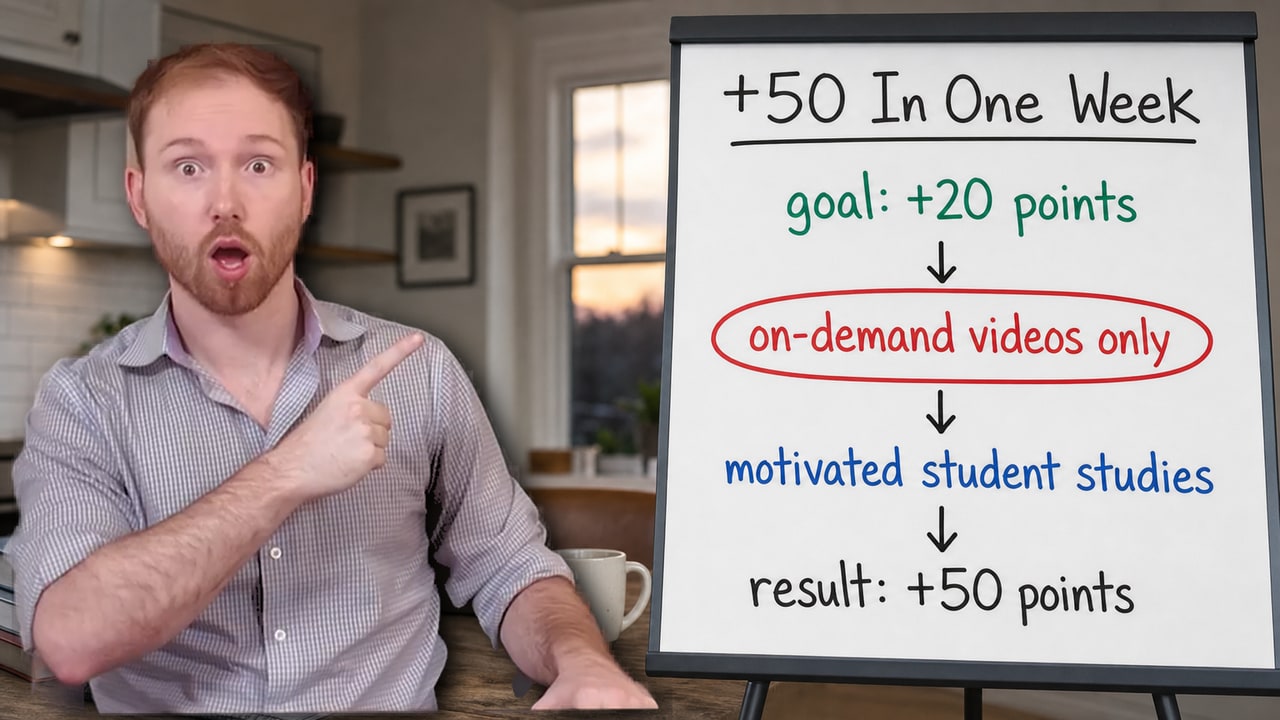 What Structured SAT Prep Adds Beyond a Week of Videos
Quick answers
How many minutes a day should my teen study for the SAT?
**The College Board suggests 15 to 30 minutes a few days each week in the months before the test.** Short, regular sessions build skills and confidence without burning a student out.
Is two weeks enough to study for the SAT?
**Two weeks is rarely enough for a big increase.** Carson calls anything under six weeks a crash course. Large gains in that window usually happen only when test-taking strategy is the student's sole problem.
Is 8 weeks of SAT prep enough?
**Eight weeks is a solid window, and it is the one Carson calls the sweet spot for most students.** He ties a 150-point guarantee to an eight-week start. For an exceptional jump, he suggests three to four months.
How many points can 20 hours of SAT practice add?
**College Board research associates 20 hours on Official SAT Practice with a 115-point gain.** That is an average across students, so your teen's result may be higher or lower.
Can my teen study for the SAT on their own?
**Yes, a motivated student can raise a score with free tools like Khan Academy and YouTube.** Structured prep adds someone who keeps them on schedule and explains each missed question right away.
What is the highest possible SAT score?
**The highest SAT score is 1600.** The test is scored 400 to 1600, with Reading and Writing and Math each scored 200 to 800.
Sources
- College Board: How much time should my child study on Official SAT Practice?
- College Board: SAT dates and deadlines
- College Board: SAT Suite of Assessments
Free guide
Get the free SAT Gap Guide.
A short guide to finding the questions that cost the most points, and what to practice first.
What's new on this page
October 19, 2026: Published.