
A good PSAT score for a freshman is any score that gives your teen a clear starting line, because the freshman PSAT does not count for anything. In Carson Flowers' example, a freshman who scores 1000 and keeps reading and doing well in math class might reach about 1100 as a sophomore and 1100 to 1250 as a junior.
A 1000 on the Freshman PSAT Is Just the Starting Line. Carson Flowers · 2:05 · October 20, 2026 · Jump to: 0:00 The question, 0:10 Carson's answer, 1:38 What to do next
| Grade | PSAT score in Carson's example | What drives it |
|---|---|---|
| 9th grade | 1000 | Starting line, before any SAT prep |
| 10th grade | About 1100 | Reading regularly, strong grades in Algebra I and Geometry |
| 11th grade | About 1100 to 1250 | Algebra II, steady reading, effort in math class |
On this page
What does a freshman PSAT score tell you?
How much can a freshman's score grow by junior year?
What should a freshman do after the PSAT?
The misconception: the freshman PSAT predicts the SAT score
What does a freshman PSAT score tell you?
It tells you where your teen starts, and the trend after it matters far more than the number itself.
Here is a question we hear a lot: your freshman took the PSAT at school this week, scores are not out yet, and you want to know what number should make you relax. The honest answer is that no freshman score is final. Colleges never see it. It is a snapshot taken years before the test that counts.
Before you judge the number, check which test your teen took. The PSAT/NMSQT is scored 320 to 1520, a little below the SAT's 400 to 1600, and our post on why the PSAT tops out at 1520 explains the gap. Many schools give freshmen the PSAT 8/9 instead, which uses its own scale [VERIFY: PSAT 8/9 score range on College Board's PSAT 8/9 score page]. Comparing a PSAT 8/9 score to an SAT score is apples to oranges.
The score report also shows section scores for Reading and Writing and for Math. Those two numbers are where the useful information lives, because they show which side needs work while there is still plenty of time.
If you want a simple way to see where your teen's score stands and what closes the gap, our free SAT gap guide walks through it in plain terms.
Free guide
See exactly where your teen's points are hiding.
A short guide to finding the questions that cost the most points, and what to practice first.
How much can a freshman's score grow by junior year?
Quite a bit, often without formal prep, as long as the reading and math foundations keep getting stronger.
Carson's example starts with a freshman who scores 1000. As a sophomore, that student would probably land around 1100. As a junior, somewhere between 1100 and maybe 1250. His condition is the important part: the student is reading, doing well in school and trying in math class. When those habits are in place, you should see the score climb slowly, year after year.
The reason is simple. The PSAT and SAT test math your teen has not finished learning in ninth grade. A freshman sitting in Algebra I is being tested on material from Geometry and Algebra II too, so some of the early gap closes as the classes do.
Focused prep later can add more on top of that natural growth. Jonathan, a 10th grader we worked with, went from 1020 to 1220 in 8 weeks of 1-on-1 tutoring with Carson. You can read how Jonathan gained 200 points, and our guide to how much SAT scores can improve covers the bigger picture.
What should a freshman do after the PSAT?
Focus on core classes and reading, which Carson calls the fundamentals.
On the math side, three classes carry the SAT: Algebra I, Geometry and Algebra II. Carson's advice is to make sure your teen is earning A's in them and has a teacher who is explaining the material well. If your teen is struggling at all, he recommends a private tutor now, while the class is still in front of them. A weak spot in Algebra I tends to come back and bite a junior who has to relearn the content right before the SAT.
On the reading side, his advice is even simpler. Read books. He calls early, consistent reading the single best thing a student can do for the SAT reading score, and by far the most important.
That can look like a novel on the nightstand or a nonfiction book about a sport your teen loves. What counts is that it happens most weeks, for years. If you are weighing course levels for next year, our post on whether colleges care about honors classes may help.
The misconception: the freshman PSAT predicts the SAT score
It does not, and Carson says the sophomore and junior PSATs are the ones that tend to represent what a student will get on the real exam.
Parents sometimes see a freshman score and assume it locks in the SAT result. A ninth grader has two or more years of math and reading growth ahead, so the early number mostly reflects what has not been taught yet. Some families panic over a low score. Others relax too much after a high one. Both are reading too much into a single fall morning.
Carson's view is that it is not too early to pay attention, because a freshman score shows you the starting point. Just do not treat it as a forecast. Our post on how well the PSAT predicts the SAT goes deeper on what the later scores can tell you.
When should real SAT prep start?
Not in ninth grade, according to Carson, who would hold off on strict SAT prep and build reading and math first.
Ninth grade is not too early to begin preparing, in the broad sense. Good grades in Algebra I, a tutor if a class goes sideways, and a reading habit are all preparation. Timed practice tests and SAT strategy work make more sense once the sophomore or junior PSAT shows where your teen really stands.
When that time comes, our guide to when to take the SAT lays out the timing. Until then, if you want a clear picture of the gap between today's score and the score your teen's colleges look for, download the free SAT gap guide and keep it for sophomore year.
More answers from Carson
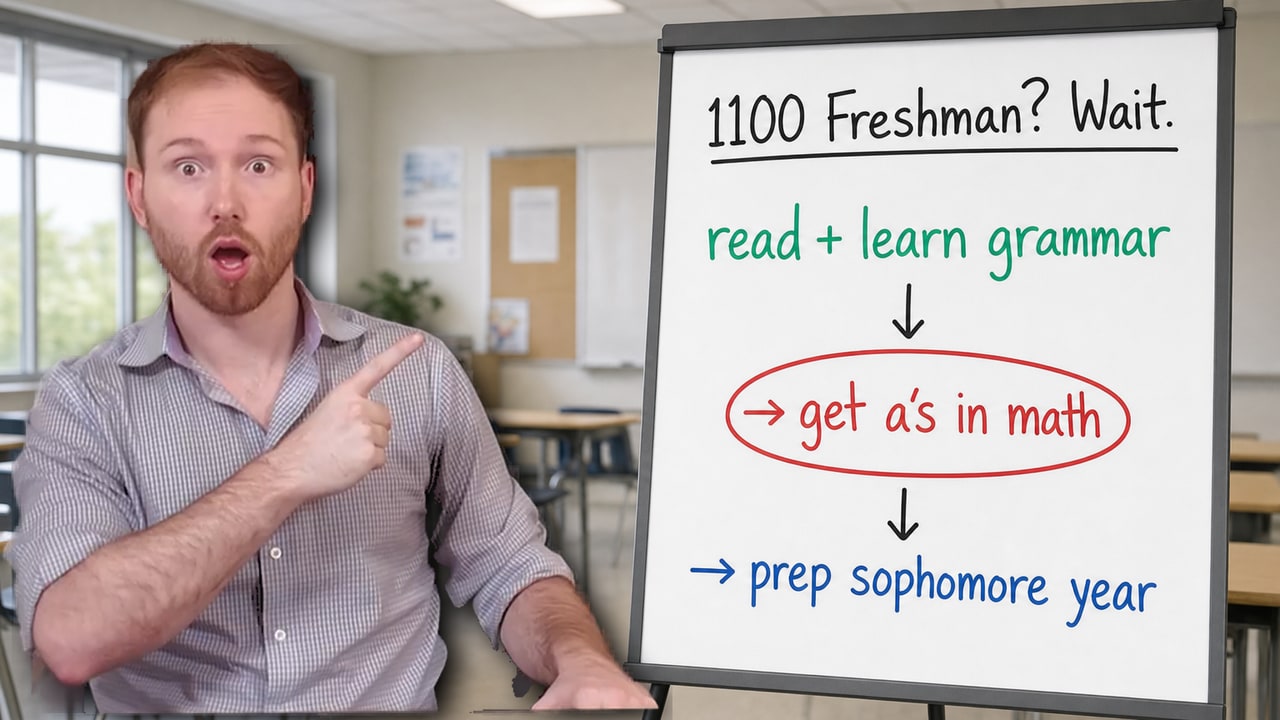 How Early a Freshman With an 1100 PSAT Should Start SAT Prep
2:35
Quick answers
Is 1000 a good PSAT score for a freshman?
Yes, 1000 is a reasonable starting line for a freshman. In Carson's example, a freshman at 1000 who keeps reading and doing well in math might reach about 1100 as a sophomore and 1100 to 1250 as a junior.
Should my freshman take the PSAT?
Yes, if the school offers it, because the score counts for nothing and shows you a starting point. Use the section scores to spot whether reading or math needs attention first.
Does the freshman PSAT count for National Merit?
No. The PSAT/NMSQT taken as a junior is the National Merit qualifying test, so a freshman score has no effect on it.
How good is a 1480 on the PSAT?
A 1480 is very high. The PSAT/NMSQT tops out at 1520, so a 1480 is just 40 points below the maximum.
Should a freshman start SAT prep?
Carson would wait on strict SAT prep in ninth grade. He recommends strong grades in Algebra I, Geometry and Algebra II, a tutor if a class is a struggle, and reading books consistently.
Sources
- College Board SAT Suite of Assessments
- College Board: SAT Dates and Deadlines
- [PDF] Fall 2026 PSAT 8/9 Understanding Scores for Students and Families
Free guide
Get the free SAT Gap Guide.
A short guide to finding the questions that cost the most points, and what to practice first.
What's new on this page
October 26, 2026: Added Carson's video: How Early a Freshman With an 1100 PSAT Should Start SAT Prep.
October 25, 2026: Published.