
No. The PSAT is not harder than the SAT. It is a little easier, which is why it is scored 320 to 1520 instead of 400 to 1600, and it is still one of the most accurate previews you will get of your teen's real SAT score.
Your PSAT Score Is the Best SAT Baseline You Have. Carson Flowers · 1:05 · October 18, 2026 · Jump to: 0:00 The question, 0:04 Carson's answer, 0:34 What to do next
| What | Number |
|---|---|
| PSAT/NMSQT score range | 320 to 1520 |
| SAT score range | 400 to 1600 |
| SAT section scores (Reading and Writing, Math) | 200 to 800 each |
| Gap between the top PSAT score and the top SAT score | 80 points |
| Sophomore PSAT score Carson calls about average | 1010 |
| Score gain Carson calls significant | 200 points |
| 2026-27 SAT weekend dates after October | Nov 7 and Dec 5, 2026; Mar 6, May 1 and Jun 5, 2027 |
On this page
How much harder is the SAT than the PSAT?
Does the PSAT predict your SAT score?
The misconception: the PSAT is just practice, so the score does not matter
What a PSAT score tells you about your teen's SAT potential
How much harder is the SAT than the PSAT?
A little, and mostly at the top end. The PSAT/NMSQT is scored from 320 to 1520. The SAT is scored from 400 to 1600, with Reading and Writing and Math each worth 200 to 800. That 80-point gap at the top is the clearest sign of the difference. The SAT stretches higher, so the students aiming for the very top have more ground to cover on it.
For most teens the day itself feels familiar. The SAT is digital and taken in the Bluebook app, and the free practice PSATs Carson points families to are in Bluebook too. A student who has sat a PSAT already knows the screen, the pacing and the feel of a timed section. That familiarity is worth something on its own, especially for a teen who gets nervous. If that is your child, our guide on helping a teen with test anxiety has steps you can start this week.
So when a parent asks whether the PSAT is harder, the honest answer is that it is the gentler of the two. The more useful question is what the PSAT score tells you, and that is where it earns its keep.
If your teen just got a PSAT score and you are not sure what gap it leaves to the colleges on their list, our free SAT gap guide walks you through the math in a few minutes.
Free guide
See exactly where your teen's points are hiding.
A short guide to finding the questions that cost the most points, and what to practice first.
Does the PSAT predict your SAT score?
Yes. Carson Flowers finds the PSAT a very accurate prediction of what a student will score on a practice SAT and on the real SAT. In his words, PSATs are "fantastic baselines," and they should be taken seriously.
A question we hear a lot: "He just did his PSAT this week, so that should give us a good baseline?" Carson's answer was an immediate "absolutely." The catch is effort. The prediction only holds if your teen sits down and does their best, the same way they would on a real test day. A PSAT rushed through on a sleepy Wednesday morning tells you less than one taken seriously.
Once you have an honest number, the plan writes itself in rough form. You know where your teen is now. You look up the scores at the colleges they care about. The distance between the two is the work. Carson puts it simply: you "build a plan from what their current score is to get 'em to where they need to be."
How big that distance can realistically be is its own question, and we cover it in how much an SAT score can really improve.
The misconception: the PSAT is just practice, so the score does not matter
The PSAT matters in two ways: it is the National Merit qualifying test for juniors, and it is the best baseline you have for the SAT. Many families treat it as a dress rehearsal and tell their teen not to stress. Lowering the pressure is kind. Telling them it does not count can backfire.
For a junior, the PSAT/NMSQT is the test that decides National Merit qualification, so a careless sitting can close a door that only opens once. For a freshman or sophomore, the stakes are lower, but the score is still the starting line for every decision about prep, timing and goals. A half-effort score sends you into those decisions with the wrong map.
Carson's advice is to have your child "try on the exam and do their best so you can get a really good idea of where they're going to be at." No cramming is needed. Your teen just needs to give it a real try.
What a PSAT score tells you about your teen's SAT potential
A PSAT score is a starting line, and how far your teen can go from it depends on their goals and how early they begin. Here is a question we hear in some form every fall: a sophomore scored 1010 as a freshman with no prep and is about to take the PSAT again. What is his potential?
Carson called 1010 a pretty good starting place for a sophomore, because it is about average and the student still has two years before senior year. From there he laid out the math. A 200-point bump is significant, a very good SAT increase, and it would put this student in the 1200s. Carson noted that 1200 opens a lot of doors at many different colleges and for scholarships.
Goals change the timeline:
- If the colleges on the list have an average SAT around 1100, Carson says a student can gain 100 points relatively quickly, so there is less rush.
- A goal of 1500 means a 300 to 400 point climb, and that calls for starting sooner rather than later.
Starting early does not have to mean intensive prep. Carson's suggestion for a younger student with big goals is reading books and steady practice, habits that pay off on the Reading and Writing section and everywhere else. For a sense of the hours involved once formal prep begins, see how long a teen should study for the SAT.
Should your teen prep for the PSAT in 10th grade?
Tenth grade is not too early for PSAT prep, but Carson suggests holding off on SAT prep until spring. Another question that comes up often: a daughter scored 1160 as a freshman and is waiting to take her sophomore PSAT. Is it too soon to prepare?
Carson's answer was no. If preparing helps your daughter feel comfortable with the exam, and helps you feel better too, it is a reasonable step. Bluebook has multiple free practice PSATs, which is the easiest place to begin, and plenty of providers help students get ready for the PSAT.
SAT prep is a separate decision. For a sophomore, Carson's advice is to wait until spring, then use the new PSAT score as the baseline for that plan. When the first real SAT should land on the calendar depends on the student, and we lay out the options in when your child should take the SAT.
Every college sets its own testing and superscoring policies, so check each college's policy directly rather than relying on any summary, ours included.
If your teen's PSAT score is in and you want to see the distance to their target schools laid out plainly, download the free SAT gap guide. It turns the score you have into a starting plan.
More answers from Carson
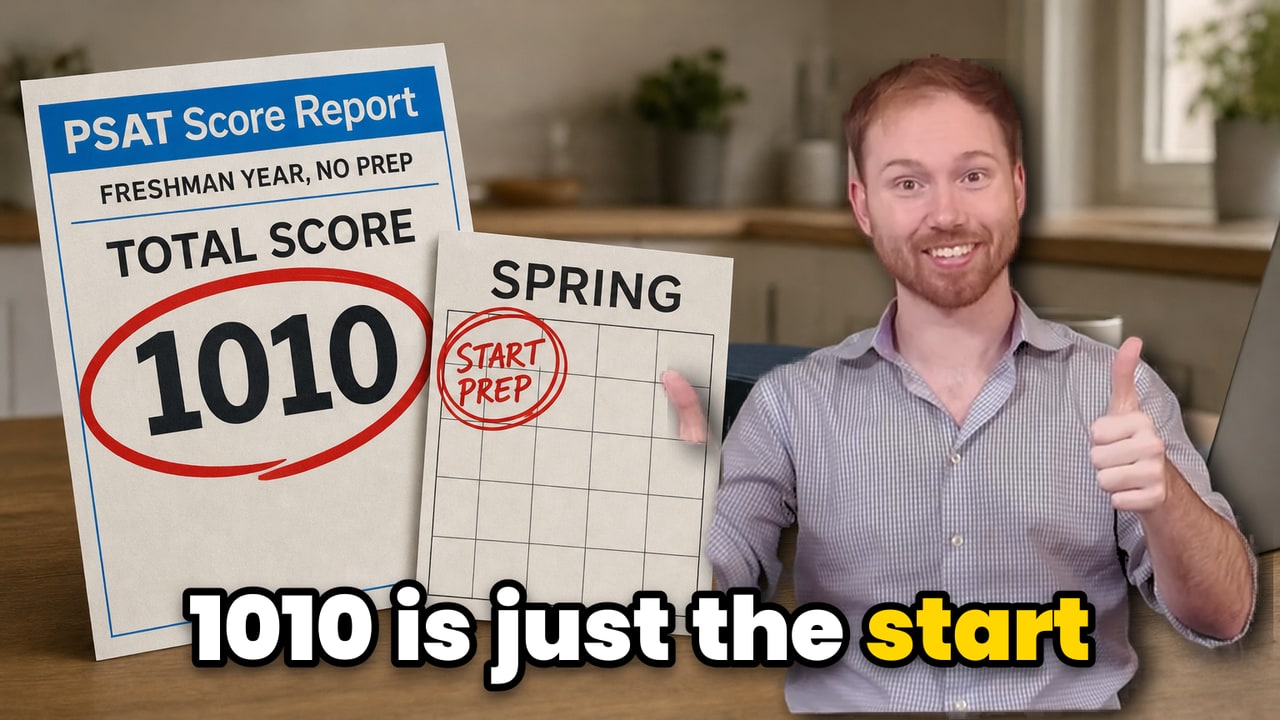 A 1010 With No Prep Is a Starting Line, Not a Ceiling
1:43
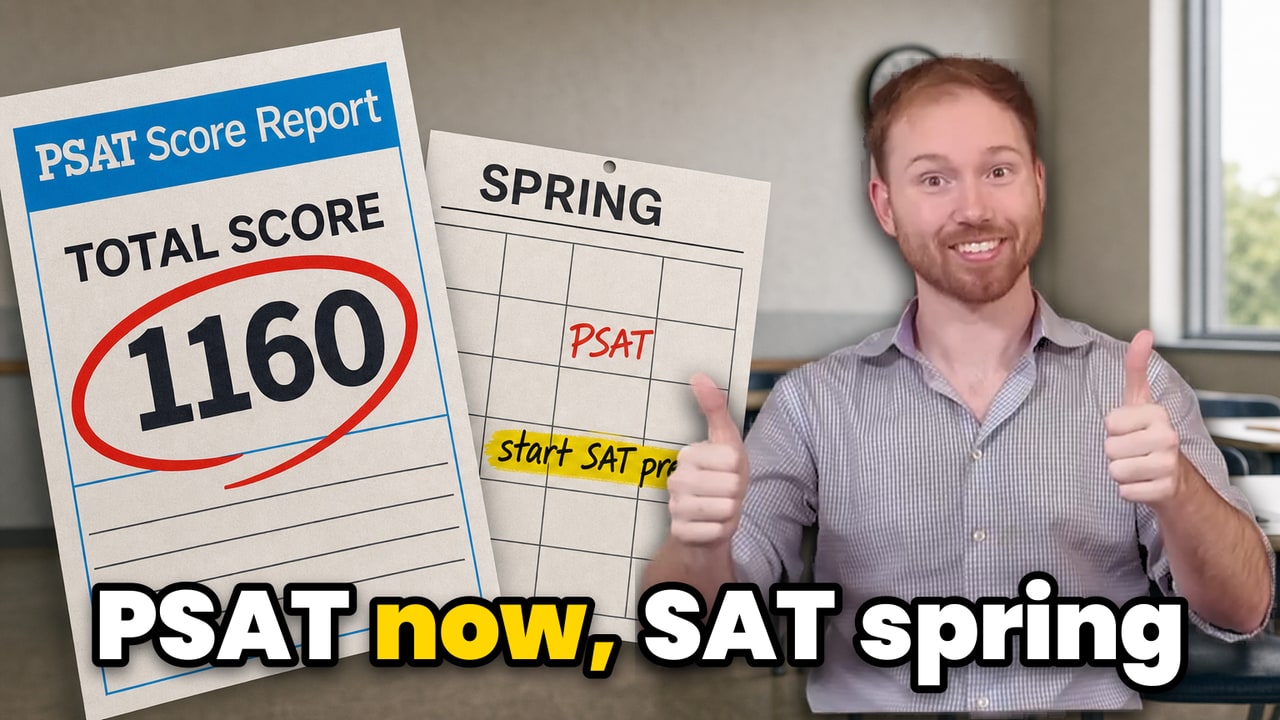 Tenth Grade Is Not Too Early for PSAT Prep After a 1160
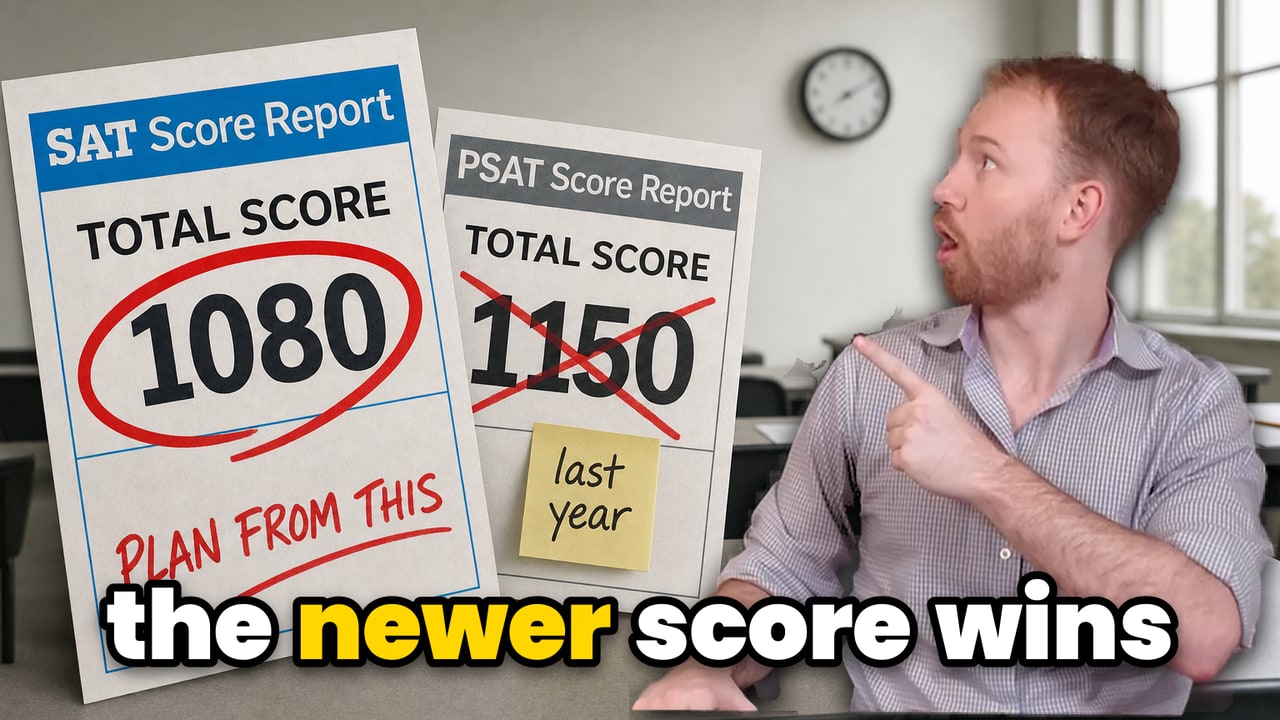 Why an 1150 PSAT Became a 1080 on the Real SAT
Quick answers
Is the PSAT math easier than SAT math?
Slightly, and mostly at the high end. The PSAT's highest possible total score is 1520, while the SAT's is 1600, so the SAT reaches further for the strongest students.
Can the PSAT predict an SAT score?
Yes, when your teen takes it seriously. Carson Flowers finds the PSAT a very accurate prediction of both practice SAT and real SAT scores, as long as the student does their best on it.
Is 900 a bad PSAT score?
No, it is a starting point. Carson calls 1010 about average for a sophomore, and he describes a 200-point gain as significant, so a younger student starting near 900 has real room to grow with time and practice.
Is the SAT still required for college?
It depends on the college. Testing policies belong to each school, so check the admissions page of every college on your teen's list.
Is 10th grade too early for PSAT prep?
No. Carson says 10th grade is not too early, and Bluebook has multiple free practice PSATs your teen can start with.
When should SAT prep start after the PSAT?
For most sophomores, in the spring. Carson suggests waiting until then, unless the goal is a 300 to 400 point jump, in which case starting sooner helps.
Sources
Free guide
Get the free SAT Gap Guide.
A short guide to finding the questions that cost the most points, and what to practice first.
What's new on this page
October 22, 2026: Published.