
Yes, SAT practice tests help, but only when your teen reviews every missed question and learns the content or strategy behind it. Taking one Bluebook test after another with no learning in between usually leaves the score right where it started.
Why Taking More Bluebook Tests Won't Raise Your SAT Score. Carson Flowers · 1:29 · October 17, 2026 · Jump to: 0:00 The question, 0:12 Carson's answer, 1:02 What to do next
| What | The number |
|---|---|
| Total score range | 400 to 1600 |
| Each section (Reading and Writing, Math) | 200 to 800 |
| Modules per section | 2, and the second module adapts: slightly harder or slightly easier |
| Time in the seat | At least two hours, longer with approved extra time |
| Content domains covered by Tailored Practice | 8 across both sections |
| Questions to choose from per Knowledge and Skill domain in Tailored Practice quizzes | 80 |
| How often Carson suggests a full test | Every week is optional; every three weeks is enough to track progress |
On this page
Why didn't the score go up after all those practice tests?
The misconception: more practice tests means a higher score
What should your teen do between practice tests?
How often should your teen take a full practice test?
Why didn't the score go up after all those practice tests?
A practice test measures what your teen already knows, so the score only moves when something new gets learned between one test and the next.
A message we hear some version of often goes like this: a student spent months working through the free official practice tests, the score never budged, and a few weeks of focused lessons near the end were what finally moved it. Carson's answer is blunt. "The idea of taking countless Bluebooks without learning anything in between them, that's really not gonna increase your child's score."
The reason is simple once you see it. Most of the SAT is content and strategy. If your teen does not know how to handle a systems of equations question on the first practice test, nothing about sitting the sixth one teaches it. The same question type comes up, the same guess goes in, and the same points disappear. Hours go up. The score stays flat.
If your teen has already taken four or five Bluebook tests and the number is stuck, a free 15-minute call with our team is a calm way to figure out which content and which habits are holding the score in place.
Free 15-minute call
Want a plan for your teen's score?
We look at your teen's current score and the colleges on their list, and tell you what it would take to close the gap.
The misconception: more practice tests means a higher score
Volume feels like progress to a parent watching from the kitchen, yet a test with no review afterward mostly repeats the mistakes your teen already makes.
Carson is a fan of practice tests. He calls them "phenomenal" for two jobs: getting a high volume of real questions in front of a student, and measuring whether prep is working. Both jobs depend on what happens after the test ends.
Here is how he puts the fix: "Make sure they're really reviewing every question that they might get wrong and are learning along the way, 'cause a lot of it is content-based and strategy-based. So if they're not changing their strategies and they're not learning the content, then it's not really gonna be transferred in their score."
We do not have a reliable national figure for how many points practice or prep adds, so we will not quote one. What we can show you is how much real students' SAT scores improved and over what time frame, which is a better guide than any average.
What should your teen do between practice tests?
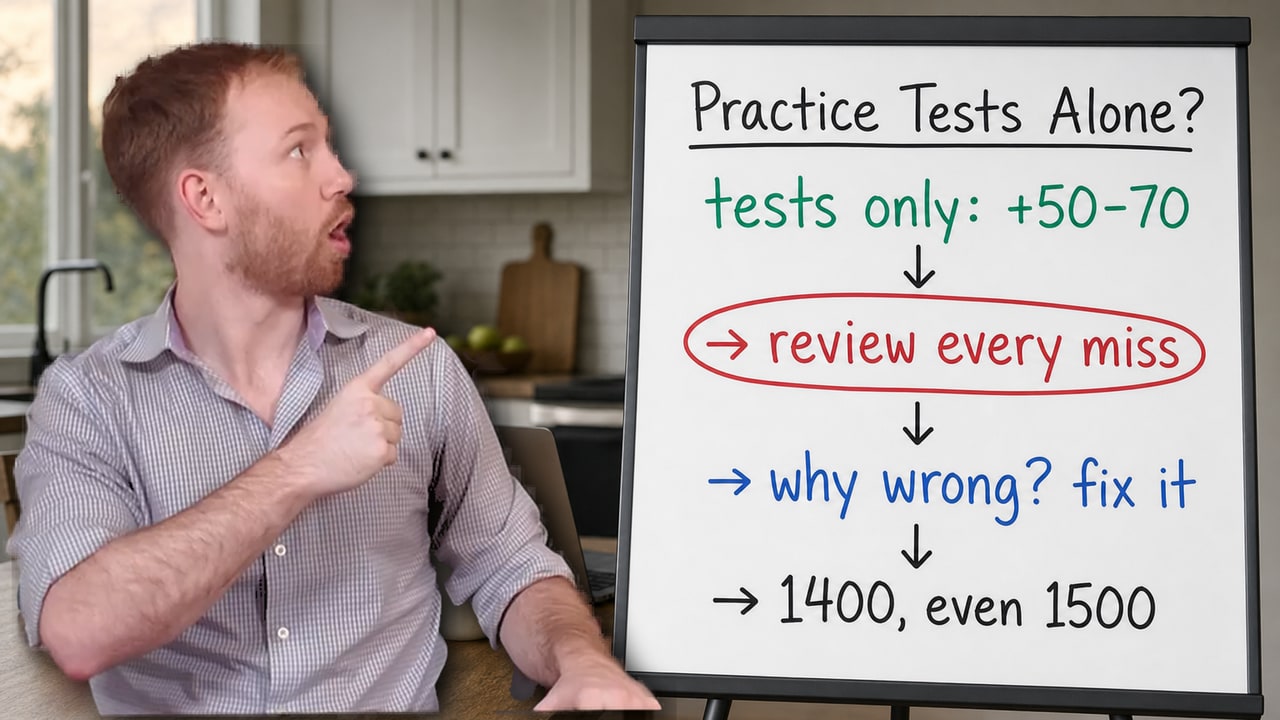
Go back through every question that was missed or guessed on, find the reason for each one, and spend the days before the next test fixing the biggest reasons.
A missed question usually falls into one of a few buckets. Your teen did not know the rule or the concept. Or they knew it and misread the question. Or they ran out of time and rushed the last few. Each bucket has a different fix, and a student who only checks the right answer and moves on never learns which bucket they live in.
- Missed content: learn the topic, then practice it on a set of questions until it sticks.
- Careless errors: slow down on the step where the slip happened, such as rereading what the question is asking for before choosing.
- Timing: practice the habit of flagging a hard question and coming back later, so one problem cannot eat three minutes.
College Board's own tools make the content part easier. After a Bluebook test, your teen can open My Practice and use Tailored Practice, which pulls real questions from the official Student Question Bank and sorts them across the eight content domains in Reading and Writing and Math. Your teen can build a quiz from 80 questions in each Knowledge and Skill domain and get answer explanations after each one. Khan Academy also offers free lessons tied to the official skills.
Carson's rule of thumb: every time your teen takes a test, they should have learned some new topics and tried some new strategies since the last one. That is the step that turns a test into a higher score.
How often should your teen take a full practice test?
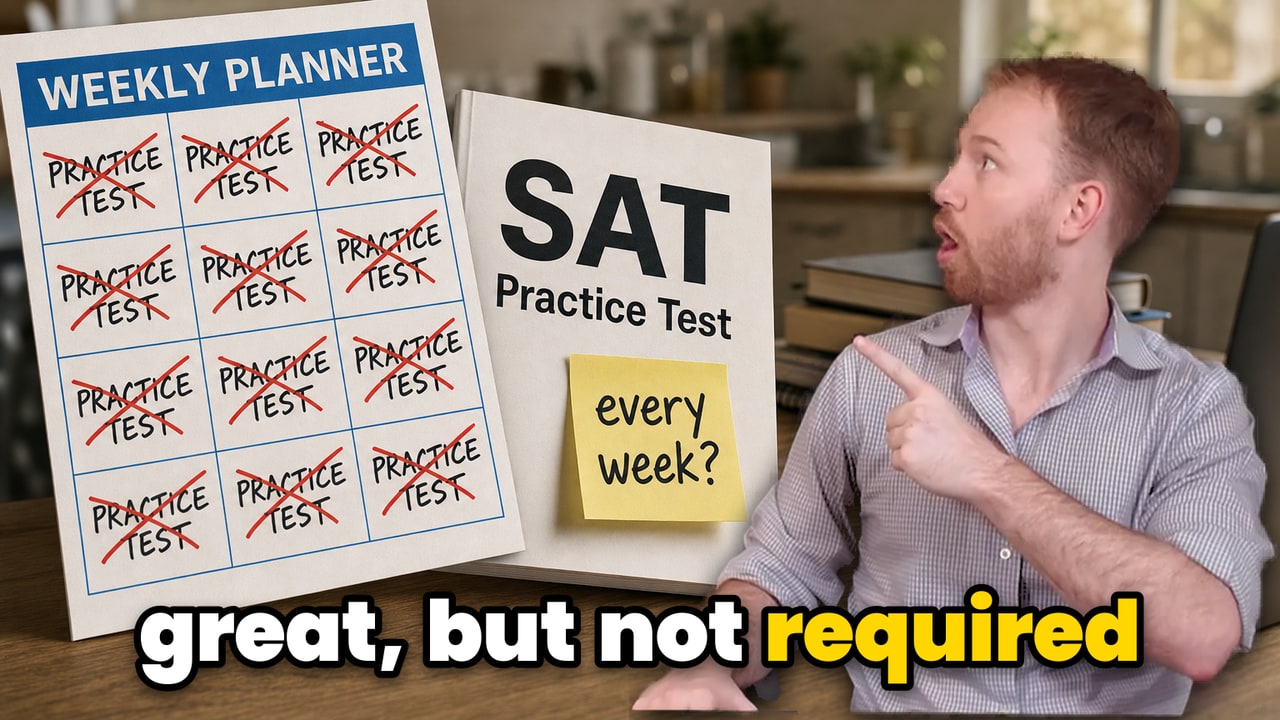
A full test every week is optional; one every few weeks is enough to check progress, as long as the weeks in between go to learning.
Parents ask Carson this directly, and his answer is no, a weekly full test is not required. Some programs assign one every week because it is an easy assignment to give and simple to review. Others test every three weeks or so to see whether the student is recognizing topics and whether the score is climbing. Carson likes weekly tests in his own programs because they let him monitor progress, but he is clear that a student does not need them.
Where full tests earn their place is stamina. The SAT takes at least two hours, and much longer for a student with approved extra time. Carson hears parents say a two-hour class sounds too long, and his reply is that the real test is at least that long. Sitting still and focused for that stretch, under the clock, is a skill your teen builds by doing it a few times before test day. If nerves are part of the picture, here is how to help a nervous teen settle in on test day.
How do you make a practice test count?
Treat it like the real morning: a desk, no phone, the full timing, and the same Bluebook tools your teen will use on test day.
College Board's own advice for Bluebook practice tests lines up with Carson's. Use the test to try strategies, such as reading the questions before the passage in Reading and Writing, or flagging any question your teen cannot answer in about 30 seconds. Some students do better one way and some the other, and a practice test is the cheap place to find out.
Pacing matters because both sections have two modules, and the second module's questions shift slightly harder or slightly easier. Bluebook practice tests use the same adaptive setup, so your teen can feel that shift before it counts. College Board also suggests a desk or table instead of the couch or a bedroom, which sounds small and makes the score more honest.
Then there are the tools: highlighting and underlining, a line reader, an answer eliminator, a flag for review, and a built-in Desmos graphing calculator for the whole Math section. A student who practices with them uses them without thinking on test day. Our guide covers how to use the built-in Desmos calculator on SAT Math.
And if the most recent official score came back below the practice scores, read what to do when an SAT score comes back lower than hoped. When you are ready to talk through a plan, Carson's team will spend 15 minutes on the phone with you, free, looking at where the points are going.
More answers from Carson
 Why Weekly SAT Practice Tests Are Optional but Stamina Is Not
2:01
 What Raises a 1200 SAT Score More Than Practice Tests
Quick answers
Are College Board SAT practice tests accurate?
The official Bluebook practice tests are the closest thing to the real SAT you can get. They run in the same app and use the same two-module adaptive format as the real test.
What's the best SAT practice test to take?
Start with the free official practice tests in College Board's Bluebook app. College Board says there is no better way to study than an official practice test in Bluebook, and the follow-up Tailored Practice uses real questions from its Student Question Bank.
Does the SAT get harder if you do better?
The second module can get slightly harder. Each section has two modules with the same number of questions, and the mix in the second module is either slightly more difficult or slightly less difficult than the first.
Does my child need to take a full practice test every week?
No, a weekly full test is optional. Carson says one every few weeks is enough to track progress, and the learning between tests is what moves the score.
Can my teen practice with accommodations in Bluebook?
Yes, any student can try built-in accommodations like text-to-speech on practice tests, but that is not approval for the real SAT. College Board asks the school's SSD coordinator to request accommodations at least seven weeks before test day.
Sources
- College Board: SAT Suite Practice and Preparation
- College Board: How to Use Bluebook Practice Tests
- College Board: SAT Suite of Assessments
- Know Your Dates and Deadlines - College Board Accommodations
Free 15-minute call
Find out how far your teen is from the score they need.
We look at your teen's current score and the colleges on their list, and tell you what it would take to close the gap.
What's new on this page
October 22, 2026: Published.