
Yes, your teen should still take the SAT when colleges are test optional. Test optional means a college will read an application without a score, and a score at or above that college's average still makes the application stronger.
Is Test Optional a Reason to Skip the SAT? Carson Flowers · 2:06 · October 28, 2026 · Jump to: 0:00 The question, 1:35 What to do next
| College | Location | Policy on College Board's list |
|---|---|---|
| Georgia Institute of Technology (Georgia Tech) | Atlanta, GA | Requires SAT or ACT |
| Purdue University | West Lafayette, IN | Requires SAT or ACT |
| Ohio State University: Columbus Campus | Columbus, OH | Requires SAT or ACT |
| Auburn University | Auburn, AL | Requires SAT or ACT for Fall 2027 |
| Stanford University | Stanford, CA | Requires SAT or ACT |
| Cornell University | Ithaca, NY | Requires SAT or ACT |
| University of Pennsylvania | Philadelphia, PA | Requires SAT or ACT |
On this page
Why skipping the SAT is usually a mistake
First, check whether the college is test optional at all
The misconception: test optional means the score does not count
When does applying without a score make sense?
Why skipping the SAT is usually a mistake
Skipping the test removes an option your teen may want next fall, and it rarely saves anything worth the trade. The catch: a score well below a college's typical range can be better left off the application, and that is a choice your teen can only make after testing.
A question we hear a lot goes like this: a son has a 3.9 GPA and a 1110 on his sophomore PSAT, a neighbor says Georgia Tech and most schools are test optional now, and the parent is ready to let him skip the SAT. Carson's answer was direct. "Yeah, I believe so," he said when asked if skipping would be a mistake. As he put it, "If he raises it two hundred points, he's in the thirteen hundreds."
His larger point is about how admissions offices read files. In Carson's experience, students who do well on standardized tests are far more likely to be admitted to a test-optional school than students who apply with no scores at all. Colleges "still value, prefer, and prioritize" applicants whose scores fall at or above the school's average. Test optional lets you apply without a score. It does not make applying without one a good idea.
A 200-point raise is a real target, and students do reach it. Jonathan, a homeschooled 10th grader, went from 1020 to 1220 in 8 weeks with one-on-one sessions scheduled before football practice. For a broader look at how much SAT scores can improve, we have a separate guide.
If you are weighing whether your teen should test, and when, a free 15-minute call with our team can sort out a plan around his schedule and the colleges on his list.
Free 15-minute call
Want a plan for your teen's score?
We look at your teen's current score and the colleges on their list, and tell you what it would take to close the gap.
First, check whether the college is test optional at all
Many colleges parents believe are test optional now require scores, so the first step is to check each school's own admissions page.
The Georgia Tech example in that question is the clearest case. College Board's BigFuture list of colleges that require SAT or ACT scores includes Georgia Tech, along with Purdue, Ohio State's Columbus campus, Stanford, Cornell and Penn. College Board counts 21 private and 42 public colleges that currently require scores or soon will, and it notes that many reinstated the requirement after trying test-optional policies during the pandemic. Not every well-known name requires scores, though. BigFuture lists SAT and ACT scores at UT Austin as considered if submitted, which means they are not required, and Harvard College says it does not require the SAT or ACT; testing there is optional and is one academic factor among many that the committee considers.
A neighbor's information can be a year or two out of date. The list changes often, so confirm the policy with each college's admissions office rather than relying on any summary, ours included.
The misconception: test optional means the score does not count
A test-optional college reads and weighs any score your teen sends; it simply does not demand one.
The University of Pittsburgh's admissions office explains it plainly. If you send scores to a test-optional school, the committee considers them. If you do not, the committee "will put more weight on the other pieces of your application." Pitt also separates test optional from test blind, where scores are ignored completely. Those are two different policies, and parents mix them up all the time.
Scores can also matter after the admission decision. Pitt notes that some schools that do not require scores for admission still prefer or require them for certain scholarships or for an honors program. College Board says the same: test-optional and test-preferred colleges may use scores to award scholarships and to place students in the right courses. If scholarships are part of your plan, our guide on whether a higher SAT score earns more scholarship money covers that side.
When does applying without a score make sense?
Applying test optional makes sense when your teen has tested, prepared, and still lands below a college's typical range, and the rest of the application is strong in the areas that school cares about.
Carson's rule for sending a score is simple: send it when it sits at or above that college's average. Below that, holding it back can be the better call. Pitt's advice points the same way, since without a score the other parts of the file carry more weight. Pitt also suggests choosing the option to see scores before deciding where they go, which keeps the decision in your teen's hands.
If your teen does apply without a score, Carson says the rest of the transcript has to do the talking for the subject the college cares about most. A tech school like Georgia Tech will look hard at math and STEM, and that math is what the SAT tests. So he points to courses such as AP Calculus, technology classes, and lab sciences like chemistry. A strong record there helps cover the missing number. Our post on whether your teen needs precalculus for SAT math explains how those classes connect to the test.
How to plan the SAT so the choice stays open
The simplest plan is to take the SAT on a calm timeline in junior year, then decide where to send it once the score is in.
The SAT is scored from 400 to 1600, with Reading and Writing and Math each scored 200 to 800. It is digital, taken in the Bluebook app, and a built-in Desmos graphing calculator is available for the whole Math section. A sophomore in this situation has time for prep and more than one sitting. The 2026-27 weekend dates include March 6, May 1 and June 5, 2027, with registration deadlines of February 19, April 16 and May 21. Many colleges superscore, taking the best section scores across sittings, but each college sets its own policy, so check each one.
Our guide to when your child should take the SAT lays out the timing in more detail. If you would like help deciding how many sittings to plan and how much prep fits around school and sports, book a free 15-minute call and we will walk through it with you.
More answers from Carson
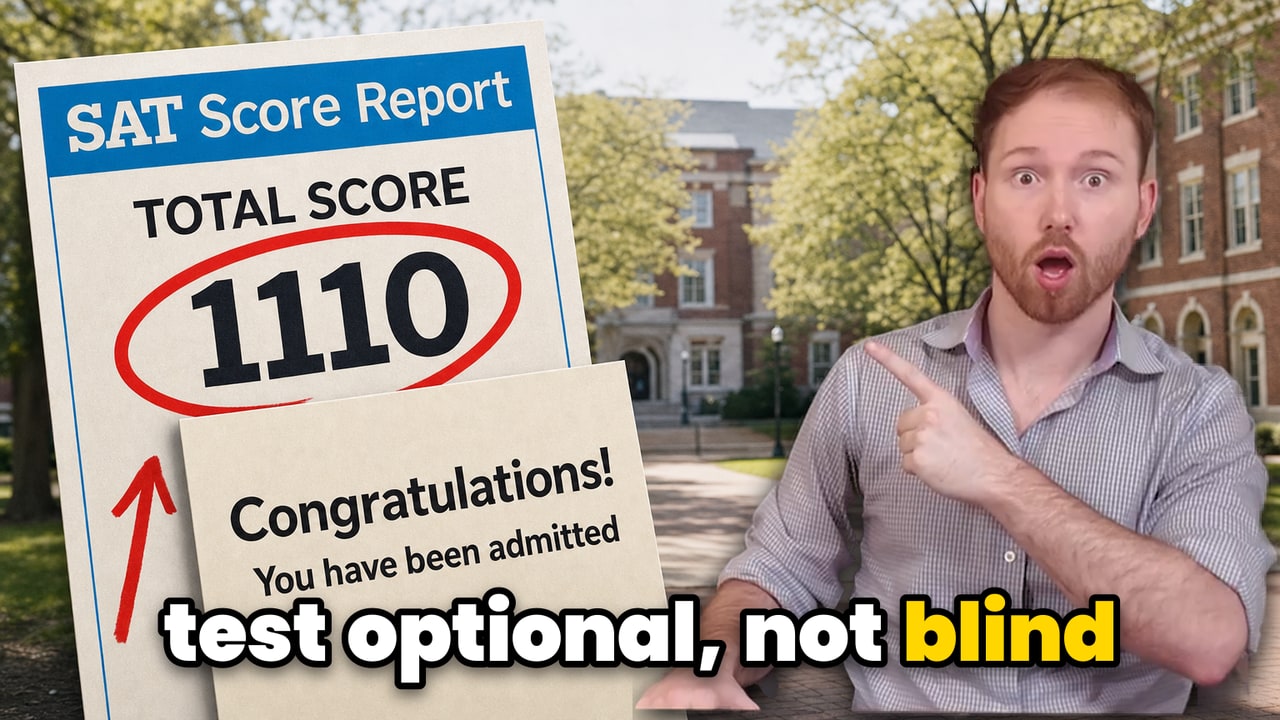 Why an 1110 PSAT Student Should Still Take the SAT
Quick answers
Is test optional the same as test blind?
No. A test-optional college considers scores you choose to send, while a test-blind college ignores scores completely, according to the University of Pittsburgh's admissions office.
Is Georgia Tech test optional?
No, according to College Board's current list. BigFuture lists Georgia Tech among colleges that require SAT or ACT scores. Confirm on Georgia Tech's admissions site, since policies change.
Will not sending scores hurt my child's application?
At a test-optional school, a missing score is not supposed to count against your teen. Pitt says the committee puts more weight on the rest of the application instead, so grades and coursework matter more.
Should you send an SAT score below a college's average?
Usually not. Carson's guideline is to send scores that sit at or above the college's average, and to lean on a strong transcript when the score falls below it.
Can SAT scores still matter for scholarships at test-optional colleges?
Yes, at some schools. College Board and Pitt both note that colleges that do not require scores for admission may still use them for scholarships, honors programs or course placement.
Sources
- Complete List of Colleges That Require SAT or ACT Scores (College Board BigFuture)
- What You Need to Know About Applying Test-Optional (University of Pittsburgh Admissions)
- SAT Dates and Deadlines (College Board)
- SAT Suite of Assessments (College Board)
- University of Texas at Austin Admissions - BigFuture
Free 15-minute call
Find out how far your teen is from the score they need.
We look at your teen's current score and the colleges on their list, and tell you what it would take to close the gap.
What's new on this page
October 28, 2026: Published.