
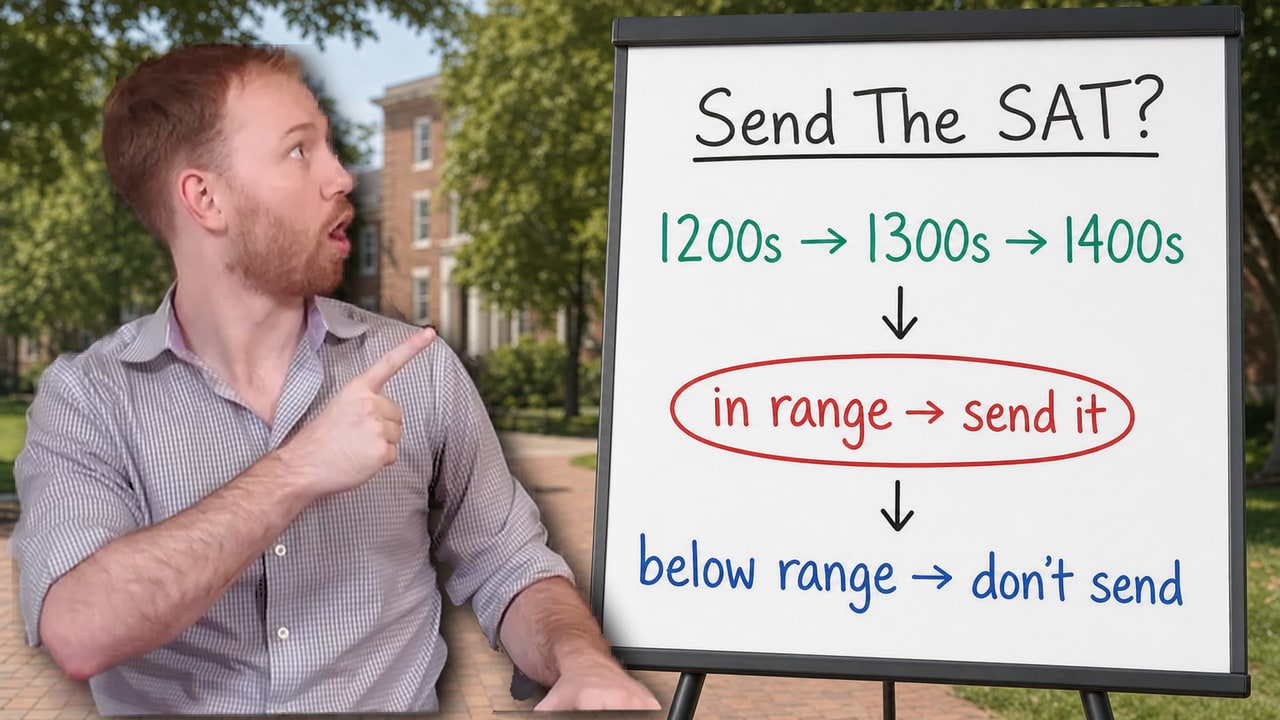
Yes, submit your teen's SAT score to a test-optional school when it lands inside or above that school's middle 50% range for admitted students, and hold it back when it falls below that range. Test-optional lets you choose whether to send a score, and the school still reads every score it receives.
Should You Take the SAT if It's Test Optional? Carson Flowers · 2:11 · October 20, 2026 · Jump to: 0:00 The question, 0:11 Carson's answer, 1:44 What to do next
| Where the score lands | Example: a school with a 1420 to 1520 middle 50% | What to do |
|---|---|---|
| Above the 75th percentile | 1520 or higher | Send it. The score is a strength. |
| Middle of the range or higher | About 1470 to 1520 | Send it. |
| Inside the range, lower half | 1420 to 1470 | Send it. Another sitting may move it higher. |
| Below the range but within about 200 points | Roughly 1220 to 1410 | Hold it for now, and prep for a retake. |
| Far below the range, with no more test dates planned | Well under 1420 | Apply test-optional and do not send it. |
On this page
How do you know if the score is good enough to send?
The misconception: test-optional means the score doesn't matter
Does sending a lower score hurt more than sending nothing?
What if your teen hasn't taken the SAT yet, or is just short?
How do you know if the score is good enough to send?
Compare the score to the middle 50% SAT range of students the college admitted. Every college publishes that range somewhere on its admissions website.
The range has two ends. The low number is the 25th percentile. Carson Flowers describes it as "usually the lowest they'll let in." The high number is the 75th percentile, "the highest they usually typically see." A quarter of admitted students scored below the low number and a quarter scored above the high one. To find it, search the school's name plus "SAT range" or "freshman profile," and use the page on the college's own site rather than a third-party summary.
Here is a concrete example. The University of Florida reports a middle 50% of 1420 to 1520 for its 2026 admitted class. A 1450 sits inside that range. A 1380 sits below it. Run the same check for every college on your teen's list, because the answer can change from school to school. A score worth sending to one college may be worth holding back at another.
Carson's rule is short: "If your score doesn't qualify, don't send it. If it qualifies you, send it." If you would like him to look at your teen's score against your actual college list, book a free 15-minute call and he will tell you which schools should see it.
The misconception: test-optional means the score doesn't matter
A test-optional school still reads and weighs every score it receives. The school that ignores scores is a test-blind school, and that is a different policy.
The University of Pittsburgh's admissions office explains the difference this way: if you send scores to a test-optional school, "the admissions committee will consider them when making an admissions decision," while test-blind schools ignore scores completely. Pitt also says a missing score won't count against an applicant. In that case, the committee puts more weight on the rest of the application.
Carson's view, from years of working with families, is that strong scores still help. "Test-optional does not mean test blind," he says. In his experience, students whose scores sit at or above a school's average are "far more likely to get accepted than applying without test scores." He puts it bluntly: applying without a score can read like a signal that the score did not qualify.
There is a second reason to keep testing. Pitt notes that some schools that don't require scores for admission "still prefer or require test scores for certain scholarships or acceptance into an honors program." Read each college's policy page for those details, and confirm with the school's admissions office rather than relying on any summary, ours included.
Does sending a lower score hurt more than sending nothing?
If the score is below a school's range, don't send it, and keep working to raise it.
A question we hear a lot: a student has a 3.9 GPA and an 1180, and the family wonders whether a lower SAT does more damage than no SAT at all. Carson's answer is that a below-range score probably won't help or hurt much. "I just don't think sending it will do anything, so don't." For that school, the test-optional route usually makes sense.
He would not stop there, though. A high GPA carries more weight when it comes with hard classes. Carson asks parents whether the 3.9 came from a schedule full of AP courses year after year or from mostly honors and regular classes. If the transcript isn't carrying the application on its own, a qualifying SAT gives admissions officers one more reason to say yes. Applying test-optional while your teen works on the score is a reasonable plan. Giving up on the test is not.
What if your teen hasn't taken the SAT yet, or is just short?
Have your teen take one SAT first. The score tells you whether prep is worth it for the schools on the list.
Carson's advice is to "take an SAT, see where they're at." If the score is within shooting distance of a school's average, prep for a retake. He uses 200 points as a working line: a student about 200 points short of a school's range should "absolutely work to raise their test score." We cover the reasoning in more detail in why a first SAT comes before prep, and the realistic size of a jump in how much SAT scores can improve.
Superscoring can help close the gap. Many colleges take the best Reading and Writing score from one sitting and the best Math score from another, but each college sets its own policy, so check every school on the list. Some families plan to prep math for one test date and reading for the next. Carson would rather prep both at once. In his experience, that tends to produce bigger gains than spending six weeks on one section for a 50-point bump. One of our students, Daniel, went from a 1300 to a 1410 superscore with one-on-one online tutoring.
Timing matters. The remaining 2026-27 US weekend dates are December 5, 2026, and March 6, May 1 and June 5, 2027. The registration deadline for December 5 is November 20. Check each college's own deadline before you count on a later sitting. If you are still deciding whether to test at all, read why test-optional colleges are still worth an SAT.
If your teen is somewhere between "close" and "not sure," a 15-minute call with Carson is free. He will look at the score, the college list and the calendar, and tell you whether a retake is worth chasing.
More answers from Carson
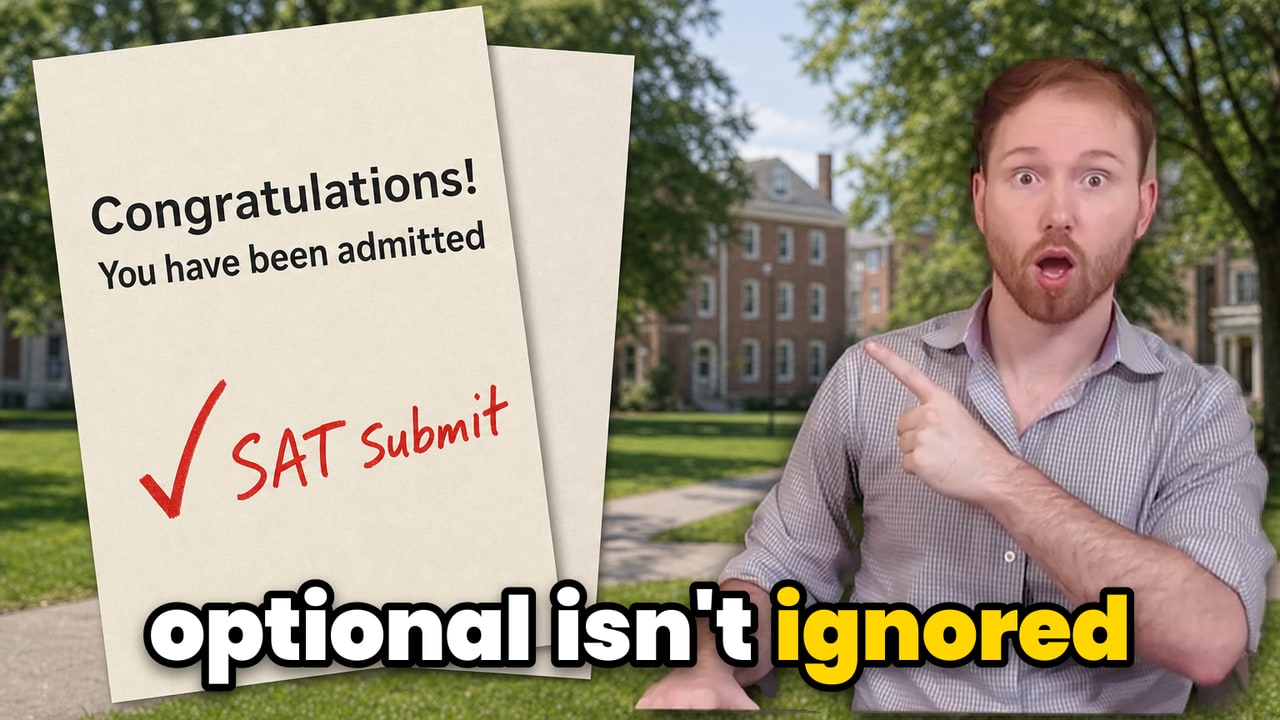 Why Test Optional Colleges Still Want Your SAT Superscore
2:01
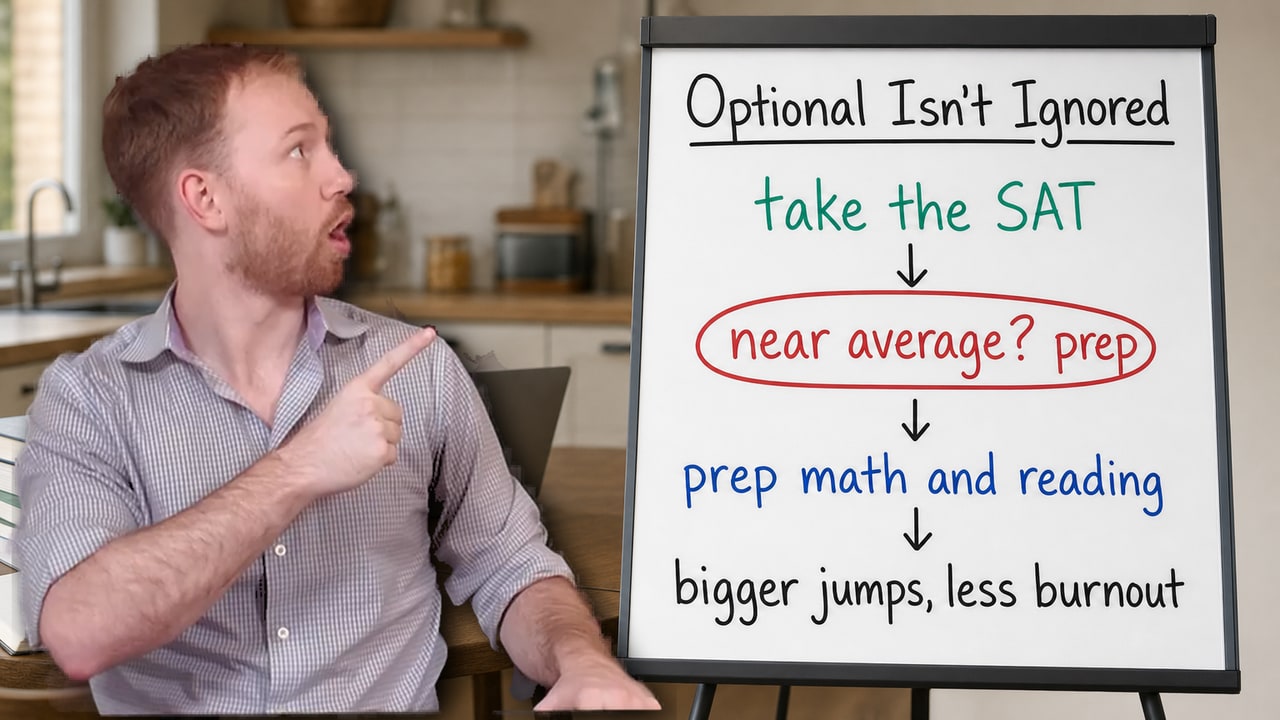 Do Test Optional Schools Want SAT Scores?
2:37
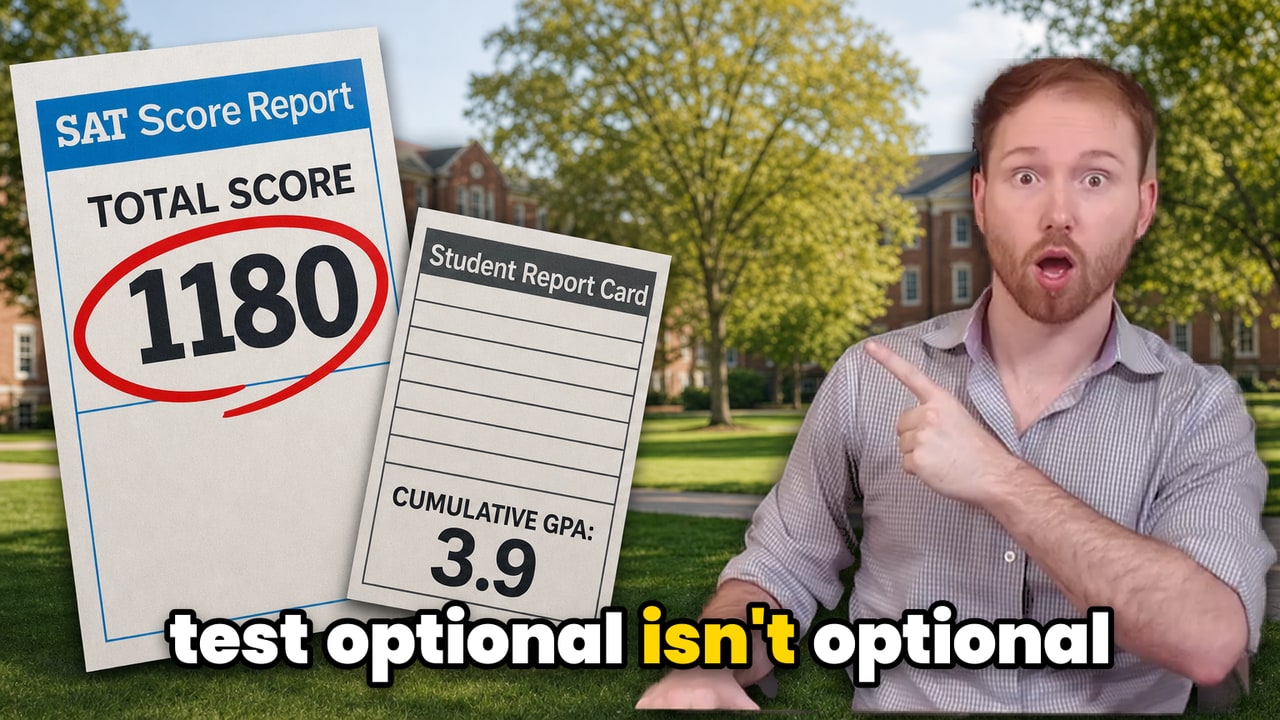 Why a 3.9 Student With an 1180 SAT Should Keep Testing
1:46
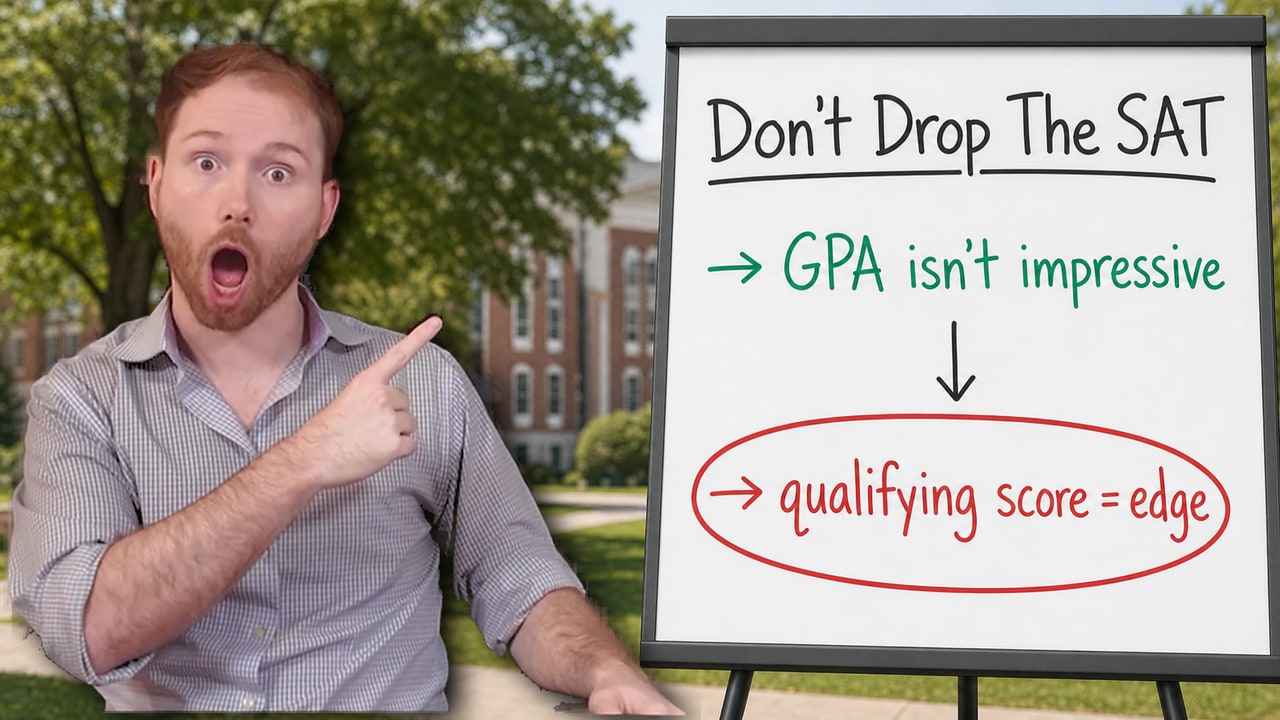 What Test Optional Really Means for a 3.9 GPA Student
 When Should You Send Your SAT Score?
Quick answers
Should you submit a SAT score if the school is test-optional?
Submit it if the score is inside or above that school's middle 50% range for admitted students. If it falls below the range, apply without it and keep working on the score.
Does a low SAT score hurt you at a test-optional school?
Usually it doesn't help, so there is no reason to send it. Carson's view is that a below-range score won't do much either way, so he tells families to leave it off.
What is the difference between test-optional and test-blind?
A test-optional school considers any score you send, and a test-blind school ignores scores even if you send them. Check which policy each college on your list uses.
Do test-optional colleges use SAT scores for scholarships?
Some do. The University of Pittsburgh's admissions office notes that some schools still prefer or require scores for certain scholarships or for honors program admission, so read each school's scholarship page.
Can you superscore SAT scores for test-optional colleges?
Often, yes. Many colleges combine the best section scores across sittings, but each college sets its own policy, so check every school before you plan around it.
Sources
- University of Pittsburgh Admissions: What You Need to Know About Applying Test-Optional
- University of Florida: Freshman Student Profile
- College Board: SAT Dates and Deadlines
What's new on this page
November 20, 2026: Published.